Saving money can feel intimidating especially when endless expenses await your paycheck and your paycheck, on the other hand, disappears before you even realize. But what if there was a way for you to build real savings without having to change your lifestyle drastically? This is exactly why the $1000 savings challenge is created in its most realistic, practical, and easy-to-follow version. You don’t have to hold back on the fun or live on instant noodles to make the challenge work, you just need a plan, and a bit of willingness and consistency to achieve something. This article will help you explore a realistic $1000 savings challenge, ensuring you stay committed to the process, and at the end of the challenge, you don’t only have $1000 saved but also develop a new sense of control and confidence towards your money.

Understand What the $1000 Savings Challenge Is

The $1000 savings challenge is a goal-based plan designed to help you save $1000 through small, meaningful, and most importantly, consistent efforts over a set period of time. This challenge is not about depriving yourself or turning it into a punishment, it’s about taking small and manageable steps that add up over time.
You can think of this challenge as a reset button that help you reconsider your unhealthy spending habits and replace them with more mindful and intentional decisions. Instead of wondering where all your money goes by the end of each month, this challenge can help you start giving every dollar a purpose, and by the time you end up with $1000 through your efforts, you’ll also have a stronger sense of confidence in your ability to manage money.
Set a Realistic Timeframe
One of the main foundations of any challenge is its timeframe, and more importantly, the realistic nature of that time period. For the $1000 savings challenge, you need to have a realistic time period that suits your income and lifestyle the best.
For example, if you want to save $1000 in 1 month, you should save about $33 per day, if your timeframe is 3 months, save around $84 per week, and if the time period is 6 months, save roughly $42 per week.
The point isn’t how fast you save, it’s about how consistently you make efforts to achieve your target. You can even use a printable tracker or calendar to visually mark every small milestone.
Break It Down into Small, Simple Steps
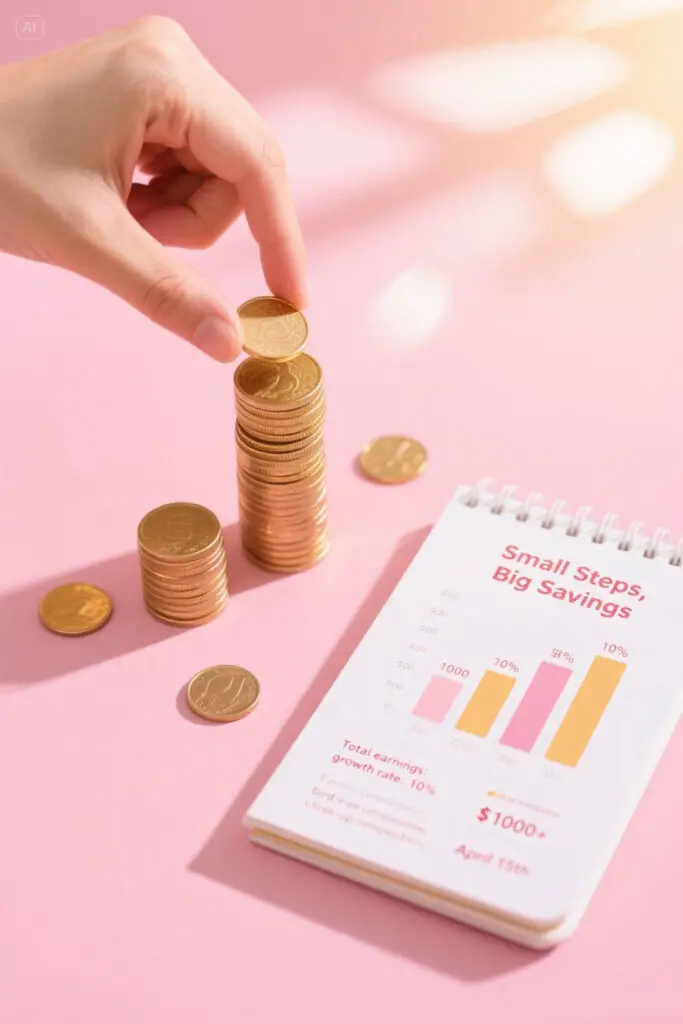
$1000 might sound like an intimidating figure at first, but when you break it down into more manageable chunks, the ultimate goal becomes achievable. Instead of thinking that you need to save a thousand dollars, think like “I need to save $5, $10, or $15 today.”
Breaking your goal into smaller daily or weekly chunks makes the ultimate target less overwhelming and more doable. You can even gamify the process, such as challenging yourself to find small ways to add extra dollars each day, like skipping one takeout order or selling something you no longer use.
Keep Your Savings Separate
One of the easiest ways to sabotage your savings is to keep both the regular money and your savings in one account. It’s easy to dip into your savings and spend them when there’s no boundary, which is exactly why it is necessary to have a separate savings account, ideally one with a debit card. You can also use a labeled envelope or transparent jar if you want to see your progress growing. When you check your balance and see it growing, it reinforces your progress and strengthens your commitment to keep going.
Identify and Cut Small, Unnecessary Expenses
Many people usually don’t realize how much money those seemingly harmless, little expenses cost. Whether it’s that $6 latte, $15 takeout, or that $20 streaming service, these small expenses add up quickly and cost you way more than you realize.
Cutting just one or two of these expenses can easily free up around $100 or more, making this tip a considerable option. Instead, push yourself to look for other alternatives, for example, you could brew your coffee at home, cook a simple dinner instead of ordering in, or review your subscriptions, and every dollar you save from these small cutbacks should go directly to your $1000 fund.
Automate Your Savings
If you often forget to transfer an amount to your savings account or struggle to save consistently, automating the process is the answer for you. Set up an automatic transfer from your checking account to your savings account on the payday, even if it’s just $25, $50, or $100.
Instead of saving the leftover money, this method allows you to pay yourself first, making your savings a priority. Automation also removes the decision-making and helps you save more consistently and effortlessly.
Try a Weekly No-Spend Day
A weekly no-spend day is one of the simplest and most effective ways to speed up your $1000 savings challenge. Pick one day each week where you commit to not spending any money at all, no takeout, no online shopping, no snacks, not even a quick coffee.
Those few dollars you would have spent on something minor can go straight into your savings fund instead. More importantly, these no-spend days help you become aware of how often you spend out of habit rather than need. Over time, this one-day pause helps you control impulse spending and appreciate the things you already have, while your savings grow quietly in the background.
Boost Your Savings with Extra Income
While cutting back on expenses is great, sometimes you can reach your goal faster by bringing in a little extra income. You don’t need a full-time side hustle, even small amounts can make a big difference.
You could sell things you no longer use, like clothes, books, or gadgets, through apps like Facebook Marketplace or eBay. If you have a bit of free time, you can take small freelance gigs, babysit, do pet sitting, or take part in online surveys for a few extra dollars. The important thing is to treat this extra income as bonus savings, not spending money. Each time you earn something extra, deposit it straight into your $1000 savings account.
Track and Celebrate Your Progress
Tracking your progress is what keeps you going when motivation starts to fade. You can use a notebook, an app, or even a printable tracker to record how much you’ve saved. Watching the numbers grow, even if it’s just by a few dollars, gives you a strong sense of pride and control.
You can set small milestones, like celebrating every $100 you save with a small, non-financial reward, maybe a relaxing self-care day, a walk in the park, or a cozy night in with your favorite movie. Celebrating progress, no matter how small, helps you enjoy the process instead of only focusing on the end goal.
Don’t Dip Into Your Savings
One of the hardest but most important rules of this challenge is to not touch your savings until you’ve reached your $1000 goal. It can be tempting to dip in when you see that growing balance sitting there, but remind yourself why you started in the first place.
Treat it as off-limits unless there’s a genuine emergency. If you keep pulling from it for small wants or impulse buys, you’ll keep restarting and never see real progress. Think of your savings as a promise to yourself, a sign that you’re capable of sticking to something meaningful.
Reward Yourself Wisely
When you finally hit your $1000 goal, you absolutely deserve to celebrate, but do it in a way that doesn’t undo your hard work. Avoid spending a big chunk of your savings on something impulsive or expensive, instead, reward yourself in a thoughtful and balanced way.
Maybe treat yourself to a nice dinner, buy something small you’ve been wanting for a while, or simply enjoy the peace of knowing you achieved what you set out to do. You can even take a moment to reflect on how far you’ve come, the small sacrifices, the discipline, the patience.
Plan What Comes Next
Reaching your $1000 goal isn’t the end, it’s the beginning of a stronger financial journey. Once you’ve built the habit, it’s time to decide what comes next. You could keep building on this momentum and start a $2000 or $5000 challenge, create an emergency fund, or begin investing a small portion each month.
You now have proof that saving money consistently works, so use that energy to plan your next step. Maybe your goal is financial freedom, a vacation fund, or paying off debt, whatever it is, try to keep the habit alive.
Conclusion
The $1000 savings challenge is about so much more than just money, it’s about taking back control of your finances, one small decision at a time. It shows you that you don’t need to earn more to save, you just need intention, patience, and consistency. Each skipped coffee, every no-spend day, and every extra dollar you set aside brings you closer to the kind of financial confidence that lasts a lifetime. By the end of this challenge, you won’t just have $1000 in your account, you’ll have a new relationship with money, one built on awareness, discipline, and self-belief, and that’s worth far more than the dollars themselves.
