• Skip to primary navigation
  • Skip to main content

Just Start Investing

We Make Investing Easy

  • Investing
    • Learn About Investing:
    • Investment Accounts
    • Online Brokerage Accounts
    • Investment Vehicles
    • Start Investing:
    • How to Invest in Index Funds
    • Start Investing with Betterment
    • Start Investing with Charles Schwab
  • Banking
    • Best Bank Accounts
    • Types of Bank Accounts:
    • Checking Accounts
    • Savings Accounts
    • CDs and Money Market Accounts
    • Online Banks vs Brick-and-Mortar
  • Credit Cards
    • Best Credit Cards:
    • Best Cash Back Credit Cards
    • Best No Annual Fee Credit Cards of 2021
    • Best Premium Credit Cards of 2021
    • Credit Card Tool: Find the Best Credit Card for Me
    • Learn About Credit Cards:
    • Types of Credit Cards
  • Blog
    • Investing
      • What is Crypto?
        • Crypto
      • What are stocks?
        • Stocks
      • What is a Real Estate Investment?
        • Real Estate Investments
      • What is an IPO?
        • IPO
    • Banking
    • Credit Cards
    • Budget
    • Finances
  • Earn with Crypto
  • Budget
    • How to Build a Budget
    • 24 Tips to Save More Money
  • Resources
  • About
    • Contact
    • Press
    • Learn More
    • Disclaimers
  • Show Search
Hide Search

Blog

25 Cent Money Saving Challenge to Save 16K in Just 1 Year

December 2, 2025 By Ana Rose

Saving money doesn’t always have to be about saving big figures, sometimes, it’s the smallest and most consistent of efforts that lead to big and meaningful results over time. The 25 cent money saving challenge is all about a simple and straightforward idea that every small coin matters. This challenge allows you to ease into saving without pressure, without feeling restricted, and without needing a high income, and instead lets you watch your money grow day by day in a way that feels almost effortless. By the end of 12 months, those tiny daily deposits come together to form something as big and rewarding as $16,000, showing you that the real magic lies not in the size of the amount you save, but in the commitment and intention behind it.

How To Use The 25 Cent Money Saving Challenge To Save 16k In Just 1 Year

Understanding How the 25 Cent Challenge Works

Illustration of a hand dropping a quarter into a savings jar with coins gradually rising on a pastel pink highlighted background.

When you begin the 25 cent challenge, the first thing you realize is how powerful small amounts can actually be when they’re handled with consistency and intention, because even a single quarter feels meaningless on its own. Saving it every day slowly teaches you that money grows quietly, when you stop overlooking the tiny amounts that usually slip through your fingers without notice. 

This shift in thinking makes you appreciate the value of little habits, and as the weeks pass, you start seeing those tiny deposits turning into something that feels surprisingly big, which keeps you motivated to continue even when the daily amount still feels small, because you know it’s building into something meaningful.

Setting Your Goal of Saving 16K in One Year

Before starting the challenge, it helps to sit with yourself for a moment and think about what you’re truly saving for, because when you attach real meaning to your goal, every deposit starts feeling personal and intentional instead of feeling like a forced routine. 

Whether you want to build an emergency fund, take a much-needed trip, start your investment journey, or simply prove to yourself that you can stay committed to something for an entire year, having a strong purpose strengthens your motivation and urges you to continue on the days when saving feels a little harder. 

Creating a Simple Daily Saving Routine

Illustration of a woman planning daily 25 cent savings on a calendar, with a pastel pink background and glowing highlights.

It becomes much easier to stay committed when you have a simple plan in place, because the structure keeps you focused while removing the guesswork from your daily saving routine. You can decide whether you want to save 25 cents on the first day and increase it by another 25 cents each day, or whether you want to follow a weekly structure where every week gets slightly bigger than the last, and choose the approach that feels realistic for your lifestyle. 

Over time, this slow and steady increase becomes a natural part of your daily routine, and you can look back and see how these tiny steps added up in a way that feels incredibly rewarding.

Choosing Where to Store Your Savings Safely

Having a separate place for your challenge savings makes a huge difference, because when the money is kept away from your normal spending account, you don’t feel tempted to dip into it for everyday wants and impulses, which protects your progress and helps the challenge move smoothly. 

You can open a new savings account or even use a physical jar if you prefer seeing your progress grow in front of you, and labeling it with something meaningful adds a personal touch that keeps you emotionally connected to your goal. The more intentional the space feels, the more likely you are to stay committed to filling it consistently throughout the year.

Tracking Your Progress Week by Week

There is something surprisingly motivating about watching your savings grow in a visual form, because when you track your daily or weekly deposits on a chart, coloring in each box or marking each milestone, the process becomes exciting and encouraging instead of repetitive or boring. 

A visual tracker gives you a way to celebrate small wins and reminds you how far you’ve already come whenever you feel like slowing down. It keeps the challenge playful and interactive, and every time you update it, you get a little boost of encouragement that helps you continue showing up, one tiny deposit at a time, until the habit becomes second nature and the results start to speak for themselves.

Find Ways to Save Extra Cents

While the foundation of the challenge is built on saving just 25 cents at a time, you’ll notice that once you start paying attention, you naturally begin finding easy places where you can save a little extra without feeling restricted or deprived. 

It could be skipping an unnecessary purchase, choosing homemade coffee, clipping a coupon, or simply becoming more mindful when spending throughout the day. And every time you choose to save those extra coins or small bills instead of spending them, your challenge fund grows faster in a way that feels effortless and satisfying.

Automate Your Savings

If remembering to save every day feels difficult or if you tend to forget when life gets busy, automation can become your best friend because it takes the pressure off your shoulders and ensures that money moves into your savings consistently without requiring daily effort. You can set up weekly transfers that increase gradually, and this simple step keeps your challenge running smoothly even during hectic weeks when you’re distracted by work or personal responsibilities. 

Automation helps eliminate temptation and excuses since the money already moves before you get a chance to spend it, and by the time you check your account, you’ll notice how these automatic deposits slowly turn into a flow of progress.

Involve Family or Friends

Turning the challenge into a shared activity can make it more enjoyable and motivating, because when you involve family members or friends, saving becomes something fun rather than a lonely task you’re doing on your own. 

You can encourage each other, share progress updates, and celebrate small achievements together, which brings a sense of community into your journey and keeps everyone accountable in a positive and supportive way. Having others join you also makes the challenge feel more like a game, and whenever one person starts to lose motivation, the rest naturally lift them up, making the entire experience more meaningful and memorable.

Revisit and Adjust Midway (6-Month Mark)

Halfway through the challenge is a great time to pause and reflect on how far you’ve come, because at this point, you’ve already built strong habits and can clearly see the progress you’ve made. 

Reviewing your financial situation allows you to check whether you’re on track, whether you can comfortably increase your weekly amounts, or whether you need to adjust things slightly to fit your budget better. This midpoint check-in gives you the chance to reconnect with your goal, strengthen your motivation, and make any necessary modifications so that the next six months feel even smoother and more manageable. 

Turn Spare Change into Savings

One of the easiest ways to grow your challenge fund faster is to treat every leftover coin or small bill as a bonus savings opportunity, because once you start noticing them, you realize how often spare change appears in your daily life. 

Whether it’s change from groceries, money found in pockets, or small bills you didn’t plan on spending, adding them to your challenge jar can make your progress grow surprisingly fast. This habit feels natural and effortless, and it helps you build a deeper appreciation for money that usually goes unnoticed, turning something as simple as spare coins into a meaningful part of your savings journey.

Stay Consistent During the Hard Weeks

There will naturally be weeks when saving feels a little heavier, especially when expenses come up or when the challenge loses its initial excitement, but these are the moments when staying steady matters the most. 

Reminding yourself why you started, looking at your progress, and remembering how proud your future self will feel can help you get through the slower phases. These tougher weeks often become the moments that shape your financial mindset the most, because they teach you patience and resilience, helping you stay committed to your larger goal even when motivation feels low.

Celebrate Your $16,000 Milestone

Reaching the final phases of the challenge and seeing $16,000 saved is an incredibly rewarding moment, because you’re not just celebrating the money itself but also the dedication  and daily commitment that carried you through the entire year. 

This amount represents hundreds of small decisions you made and moments when you chose long-term goals over short-term comfort. Take time to appreciate how far you’ve come and think about how you want to use this money in a way that brings value to your life, whether that’s investing, saving for future security, or treating yourself to something meaningful. 

Conclusion

The 25 Cent Money Saving Challenge is a beautiful reminder that big results don’t always require big beginnings, and that real financial progress often grows quietly from small but steady actions. This challenge teaches patience, discipline, and mindfulness in a gentle and approachable way, showing you that the money you once overlooked has the potential to turn into something life-changing when handled with intention. By staying committed, adjusting your habits, and celebrating your progress along the way, you not only save $16,000 but also build a healthier and more confident relationship with money that stays with you long after the year ends.
30,000 Money Saving Challenge – Save 30,000 in 52 Weeks

December 1, 2025 By Ana Rose

Saving money can sound like an overwhelming and intimidating task especially when the goal is as big as $30,000 which is why it is necessary to break it down into smaller and more manageable chunks. This idea behind the 52 week challenge is to start small and gradually build your savings over time. Over time, these small yet consistent efforts can turn into a significant amount, making every deposit worth it. Whether your goal is to build an emergency fund, save for a big future purchase, or simply take control of your finances, this challenge can be your to go for saving a big amount. This article will help you explore the dynamics of the 52 weeks challenge, ensuring that it goes smoothly.

30,000 Money Saving Challenge - Save 30,000 in 52 Weeks

Set Your Target and Timeline (Week 1)

Illustration of a woman planning her 52 week savings challenge with a calendar and $30,000 goal bar on a pastel pink background.

Before starting your savings journey, you need to set your goal clearly which in this case is $30,000 in 52 weeks. You can divide your total goal by 52 and get an average of around $577 per week. While this may sound high, you need to convert this big overwhelming goal into small pieces for the challenge to sound less intimidating. 

The key is to commit to the challenge from day one and follow it with consistency. Over time, these consistent efforts will turn into something big and meaningful, making your decision to begin with the challenge and every tiny deposit worth it. 

Create a Dedicated Savings Account (Week 1)

One of the best ways to stay consistent with the savings challenge and make sure that you deposit an amount every week is to create a dedicated savings account separate from your regular money. Having a separate account can prevent you dipping into your savings whenever the urge to spend arises, making it necessary to have one. 

You can label the account with something motivating like, “My Savings Journey” or “My $30K Goal”. This psychological trick helps remind you why you started the journey in the first place, helping you find the challenge motivating and rewarding. 

Start Small and Build Gradually (Weeks 1–4)

Illustration of gradually increasing weekly savings stacks labeled $200 to $500 on a pastel pink background.

The next step is to begin with the challenge and build habits that will help you stay consistent with it, not focusing only on the numbers. You can start small to get comfortable in the initial phases of the challenge, for example, in the first week, you can save around $200, $300 in week 2, $400 in week 3, and $500 in week 4. This way, by the end of the month you’ll have around $1,400 saved, which is a pretty good figure for the initial phases.  

Starting small can help you get used to the challenge and once you see what these deposits add up to, it can strengthen your motivation to keep moving forward. 

Adjust Your Lifestyle and Cut Back (Weeks 5–8)

As you move into the second month of your 12 month challenge, it’s time to go through your spending habits and make modifications to your spending choices. You can consider those seemingly small leaks or those areas of weakness that quietly eat away your income, whether it’s dining out frequently, grabbing coffee every morning, or subscribing to services you barely use. 

For these weeks, try saving between $550-$600 weekly, and your total can reach around $4,000-$5,000. The main catch of this stage is to adjust your lifestyle according to what matters the most to your finances at the moment, which is your savings challenge 

Automate Your Savings (Weeks 9–12)

The next step in your 52 week challenge is to make the process of setting money aside effortless and low maintenance by automating your savings. Choose a specific day for the transfer, ideally, it should be your payday, because this hack takes away the possibility of you dipping into your income when you receive your paycheck, also known as “paying yourself first”.

During these 9-12 weeks, try to save around $600 weekly, and by the end of week 12, you’ll have around $7,000 saved. 

Use Extra Income to Boost Your Progress (Weeks 13–20)

The next step in your 52 week journey is to earn extra income to boost your progress. Relying solely on a single income in today’s economy can be hard, especially when you’re working on a savings challenge as well. You can work as a freelancer and advertise your services through freelancing platforms such as Fiverr, Upwork, or freelancer.com. Moreover, you can offer babysitting or pet sitting services and even consider selling unused items in your home.

During these 13-20 weeks, keep saving $650-$700 each week and by the end of the 20th week, you’ll have around $12,000 to $13,000 saved. 

Stay Motivated and Track Your Growth (Weeks 21–28)

The next important step when you move on with the savings challenge is to remind yourself that it’s completely okay if the challenge loses its spark, what matters the most is that you stay committed and consistent to the goal you started for in the first place. You can create a visual tracker like a chart, a savings thermometer, or even a notebook to record your progress. Seeing your savings can be a great motivation and confidence booster that ensures you move on with the challenge even through the boring and dull phases. 

During these 21-28 weeks, save $700-$750 weekly so that by the end of the 28th week, you can save around a total of $17,000 

Revisit and Readjust Your Budget (Weeks 29–36)

Around this time of the challenge, it’s very likely that your financial circumstances might have taken a shift, whether you paid off a debt, earned a raise, or managed to cut more expenses. Utilize this period to review your budget and adjust your savings target if possible. Even adding an extra $50–$100 per week can make a noticeable difference and you’ll be surprised by how your mindset has evolved in these few weeks. By the end of the 36th week, make sure you have saved a total of $22,000. 

Stay Strong Through the Slower Weeks (Weeks 37–44)

As you move further along in your savings journey, it’s completely normal to experience moments where you feel tired, unmotivated, or even tempted to give up. You can look back at the sacrifices you’ve made and the amount you’ve already saved to reignite your motivation.

By continuing to save around $750–$800 weekly during these weeks, you’ll find yourself getting closer and closer to your $30,000 goal, and that thought alone can push you forward with renewed energy and determination.

Make a Final Push (Weeks 45–50)

At this point, you’re nearing the finish line of your 52-week challenge, and these last few weeks are all about giving that final push of effort and energy. This is a great time to look for small but effective ways to increase your income or reduce expenses, whether that’s selling things you no longer use, skipping a few takeouts, or finding small freelance or side hustle opportunities to earn a little extra. 

You can aim to save $800–$900 weekly during this phase, and every extra deposit will bring you one step closer to completing what once seemed like an impossible goal. 

Reach Your $30,000 Goal (Weeks 51–52)

By the final two weeks of your challenge, you’ll finally reach the most rewarding part that is seeing your hard work, patience, and persistence turn into something meaningful. Hitting your $30,000 goal is more than just a financial win, it reflects your growth and your ability to stay consistent. 

Take a moment to look back at the entire journey, from your first $200 deposit to this incredible achievement, and appreciate every bit of effort you put in. 

Plan What Comes Next 

Now that you’ve completed your savings challenge and have $30,000 in your account, it’s time to decide how to use it wisely and purposefully. You can divide your savings into different categories based on your priorities, for example, setting aside a portion for an emergency fund, investing in something long-term, or saving for a future goal like a home, travel, or education. 

The most important thing is to make sure your money works for you instead of being spent impulsively. 

Conclusion

The 30,000 Money Saving Challenge is much more than just a plan to save a certain amount of money, it’s a full-year journey of discipline and transformation. Throughout these 52 weeks, you can learn that saving isn’t just about perfection or high income, it’s more about those small and consistent efforts that build up over time. By the end of the challenge, you don’t just walk away with $30,000 sitting in your savings account, you also carry with you a sense of control, confidence, and empowerment that changes how you view money altogether. This challenge proves that even the biggest goals can be achieved when you break them down into simple, consistent steps and believe in the power of persistence.

11 Small-Budget Savings Challenges

November 30, 2025 By Ana Rose

Saving might sound like something that’s only reserved for financial experts and those with six figure salaries, but in reality, saving is more about habits and less about how much you earn. Even when your budget feels tight, there are still some small habits that can help you make room for savings. Small budget savings challenges are perfect for anyone who wants to build consistency and discipline when it comes to financial life. These challenges are fun and allow you to explore your creative side, making them a motivating way to save even if it is just a few dollars you can save a week. This article will help you explore 11 fun and exciting small budget savings challenges, helping you move towards a secure and stable financial future without having to deprive yourself completely. 

11 Small-Budget Savings Challenges

1. The $1 Daily Challenge

Illustration of a jar labeled $1 Daily Challenge filling with dollar bills on a pastel pink background.

For something meaningful yet low effort, you can consider the $1 challenge that shows you how small but intentional efforts can serve you in the long run. This challenge is all about saving $1 every day for 365 days and at the end of the challenge you’ll have $365 saved without any extra effort. 

The beauty of this challenge is that it’s simple and low maintenance, proving that saving doesn’t always have to be complex or complicated. You can use a glass jar, a small box, or even a digital savings account to track your progress, helping you become more motivated and consistent to continue with the challenge. Over time this habit can train your mind to prioritize consistency over big figures, a small mindset shift that can serve you in the years to come. 

2. The 52-Week Challenge

Another considerable option is the 52 week challenge which is all about starting small and gradually increasing the amount as you move on with the challenge. In the 52 week challenge, you save $1 in week 1, $2 in week 2, $3 in week 3, and so on to $52 in week 52. By the end of the year when you finish the challenge, you’ll have $1378 saved in a low effort yet highly effective way. 

You can also reverse the challenge if you feel like starting big and gradually moving to the easier and doable part of the challenge. The reverse 52 week challenge involves saving $52 in week 1, $51 in week 2, $50 in week 3, and so on to $1 in week 52. 

3. The Spare Change Challenge

Illustration of a hand adding coins to a spare change jar on a pastel pink background.

If you often find spare changes or small coins lying around the house, that’s your cue to start the spare change challenge. This challenge is all about saving spare change either in a jar or in a box. This challenge may sound simple and small but over a few months you’ll realize how quickly those small changes add up. 

It’s a stress free challenge as it doesn’t require you to follow strict rules or save a fixed amount, it is a flexible challenge that just involves collecting and saving any spare change. What makes this challenge a considerable option is that at the end, you can see how sometimes the most effortless of habits can result in meaningful rewards, serving as a reminder that consistency and intention matter far more than  big amounts.

4. The No-Spend Weekend Challenge

For a challenge that helps you hold back on non-essential spendings, consider the no-spend weekend challenge which involves picking one weekend a month where you commit to spend nothing on those wants or nice-to-have items. 

Instead of spending money, you can look for low cost and pocket-friendly alternatives that are just as much fun whether it’s cooking at home, going for a walk, or spending time with your loved ones doing free activities. 

Not only does this challenge help you save instantly, it also helps you realize that those seemingly necessary expenses only bring temporary satisfaction, urging you to rethink your spending choices and making necessary modifications to it. 

5. The 5-Dollar Bill Challenge

The 5 dollar bill challenge is a simple and straightforward challenge which is all about putting aside your $5 bill, whenever you get one, no questions asked. Since $5 feels small enough not to make a big difference in your day-to-day spending, it becomes an easy habit to stick with. 

Over time, you’ll start noticing that your savings are growing faster than you expected. This challenge works especially well if you handle cash regularly, and it gives you that satisfying feeling of saving without any pressure or complicated planning.

6. The Pantry Challenge

For a creative and practical challenge that puts your problem-solving and decision-making skills to work, go for the pantry challenge. The pantry challenge is all about cooking meals using only the ingredients available in your pantry. 

Not only does this challenge help you save money by reducing takeout, dining out, or getting food delivered, it reduces grocery costs, reduce food waste, helps you explore your kitchen skills, and most importantly allows you to eat nutritious and hygienic food made at home. 

Whether it’s a fun new kitchen experiment, mixing up leftovers, or using items you’ve forgotten about, the pantry challenge can be the perfect option for anyone who wants to save money while learning to make the most out of what they already have. 

7. The 30-Day Round-Up Challenge

For a simple challenge, consider the 30-day round-up challenge which is all about rounding up your purchase to the nearest dollar, $5, or $10, and saving the difference. For example, if you spent $7 on coffee, set aside $3 and save them. Similarly, if you spent $7.40, you can round it up to $8 and save 60 cents. 

While these small amounts may not seem much to help your savings grow, over time, they can add up and you won’t even feel the difference in your daily spending. What makes this challenge a considerable option is that by the end of it, you can see a surprisingly good figure saved without putting in extra effort, simply by building a habit that’s simple but highly beneficial. 

8. The Envelope Challenge

The envelope challenge is one of the most practical and eye-opening ways to get hands-on with your savings. It’s all about dividing your money into physical envelopes that represent different spending categories, such as groceries, transportation, eating out, or entertainment. You can set a spending limit for each category at the start of the month and place that specific amount of cash inside its envelope. The key is simple, once the money in an envelope runs out, you can’t spend any more in that category until the next month begins. This challenge helps you stay aware of your spending habits, prevents overspending, and teaches you how to make thoughtful financial choices. 

9. The Subscription-Free Month

In today’s world, it’s so easy to forget how many subscriptions quietly take small portions of your income every month, from streaming services to apps, magazines, and even fitness memberships. The subscription-free month challenge encourages you to cancel or pause all non-essential subscriptions for 30 days and live without them. 

At first, it may feel a bit unusual, but it can be surprisingly refreshing to realize how many of those subscriptions you barely use or even miss. At the end of the challenge, you might find that some of those paid subscriptions weren’t adding real value to your life at all, and keeping them canceled could help you save even more in the future. 

10. The 100 Envelope Challenge (Mini Version)

If you’re looking for something slightly more structured but still manageable, the 100 envelope challenge (mini version) is a great pick. The traditional version involves labeling 100 envelopes with numbers 1 through 100 and saving the amount written on the envelope you pick each day, but the mini version simplifies it for smaller budgets. 

You can use 50 envelopes or even 30, depending on your comfort level. Each time you pick an envelope, you save the number written on it, and by the end of the challenge, those small amounts will turn into a surprisingly large sum. 

11. The “Save Your Bonuses” Challenge 

The “save your bonuses” challenge is a simple yet powerful habit that focuses on putting away any extra money you earn rather than spending it right away. Whether it’s a work bonus, a cash gift, tax refund, or even a small reward from selling something you no longer need, this challenge encourages you to save it all. The best part about this challenge is that it doesn’t affect your day-to-day budget since the money isn’t part of your regular income, making it easier to save without feeling deprived.

Conclusion

Saving money doesn’t always require drastic lifestyle changes or large sums to begin with, sometimes it’s the small, consistent habits that create the biggest difference over time. These 11 small-budget savings challenges are designed to fit easily into everyday life, helping you build discipline, creativity, and mindfulness around your spending. Whether you’re collecting spare change, cooking from your pantry, or pausing your subscriptions, each challenge adds a little strength to your financial mindset. The key is to focus on progress, not perfection because every dollar saved is a step closer to financial freedom. With patience and consistency, these small efforts can turn into meaningful long-term results, giving you more control and peace of mind over your financial future.

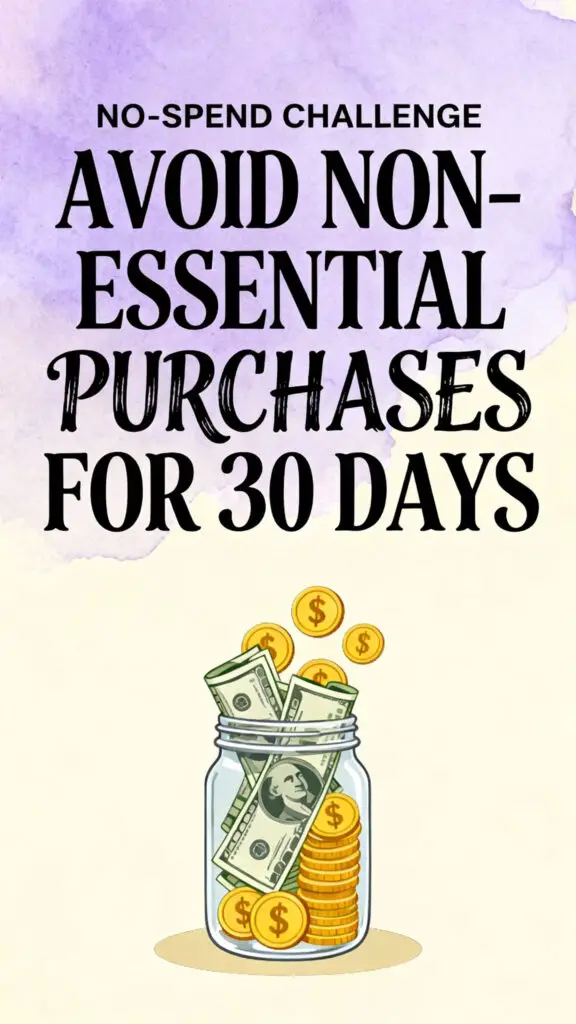
No-Spend Challenge – Avoid Non-Essential Purchases For 30 Days

November 28, 2025 By Ana Rose

Sometimes it can feel like money slips away without you even realizing whether it’s your daily coffee run, a quick snack, or an impulsive online order, and all of a sudden you come to realize that there’s no money left behind for you to spend. This is exactly where the no spend challenge comes in which isn’t about cutting off every expense because that would be unrealistic, this challenge is about spending on essentials and those basic expenses only that you can’t live without. By committing to avoid spending on non-essentials for one complete month, you can gain better control over your urges to spend and come to realize that spending on non-essentials isn’t as important as you might have thought in the past. This article will help you explore the dynamics of the no spend challenge, allowing you to become more mindful towards your hard-earned money and gain a better control over what you spend at. 

No-Spend Challenge – Avoid non-essential purchases for 30 days

Understanding What a No-Spend Challenge Really Means

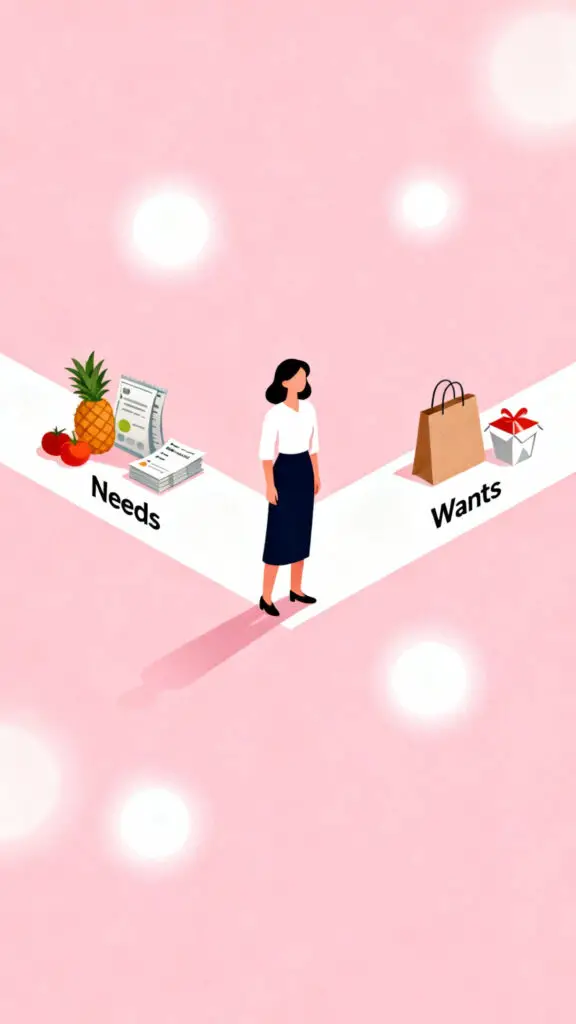
Illustration of a woman choosing between “needs” and “wants” on a pastel pink background.

Before you begin, it is important to understand what a no spend challenge actually is. A common misconception about this challenge is that it is all about saying no to every expense and depriving yourself, however in reality, this challenge is more about focusing on your needs rather than your wants and becoming more intentional with where your money goes. 

During this challenge, you can still buy groceries, pay rent, or spend on healthcare, but you avoid spending on eating out, new clothes, or random online shopping sprees. Once you go through a few days of not spending consciously, it helps you realize that many of your purchases are just habits, not essentials or purchases that are necessary for survival, urging you to rethink your spending pattern. 

Setting Clear and Realistic Rules for Yourself

The definition of needs and wants are different for everyone which is important to define what it means for you before you start the challenge. For example, going out for coffee once a week may feel like an essential expense to your social well-being and that’s completely okay, the catch is just to plan for it so that whenever you go for that purchase, it doesn’t affect your budget. 

The key is to write your expenses down clearly that you think are non-essential ones and it doesn’t hurt to cut them off for one month, whether it’s no eating out, no online shopping, or no impulse purchases. When the boundaries are set from the start, it becomes easier to stick with the challenge, leaving no room for confusion and ambiguity later on. 

Identifying What Counts as “Essential” vs. “Non-Essential”

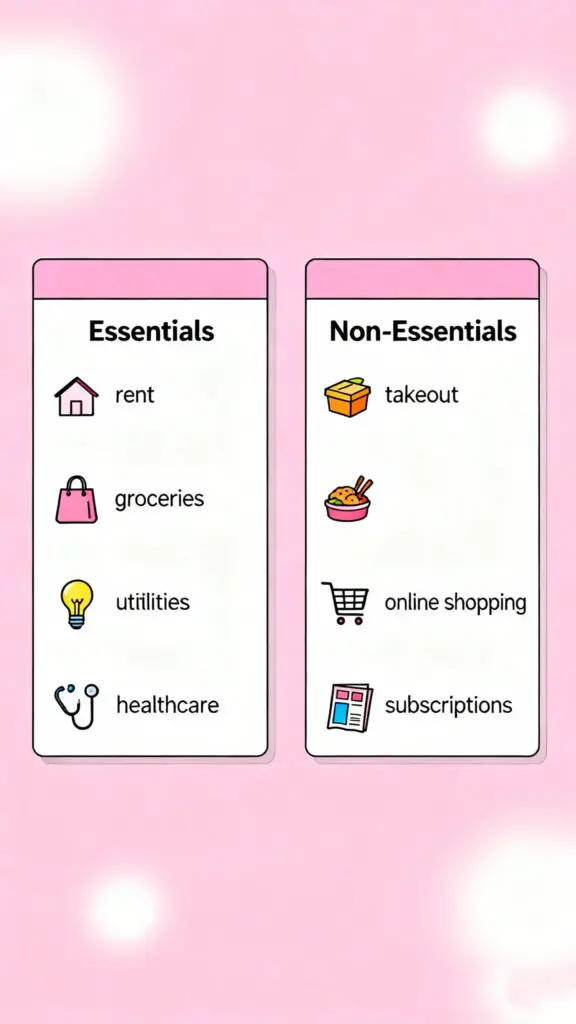
Illustration of two side-by-side lists showing essential and non-essential expenses on a pastel pink background.

The next step in the no spend challenge after you set clear goals is to identify what truly counts as an essential expense and what just feels nice to have. Essentials are the things you truly need to live, whether it’s rent, groceries, utilities, healthcare, or transportation, whereas, non-essentials are those nice-to-have items like takeout, subscriptions, or online shopping sprees that bring along temporary contentment and satisfaction. 

You can make two separate lists before you start so you can continue with the rest of the challenge without any confusion. Not only does this step help you stay organized, it also helps you stay mindful of where your money is going, allowing you to prioritize needs over wants. 

Defining Your Purpose and Motivation

The next step is to define your purpose and motivation and know the ‘why’ behind the challenge. Whether it’s for an emergency fund, paying off a debt, or simply building discipline when it comes to your financial life, defining your purpose is an essential step in the no spend challenge. 

When your goal feels personal, it becomes easier to stick to the challenge and achieve whatever the target is. You can write down your target somewhere you can see it often, whether it’s your fridge door, your room mirror, or in your wallet. The key is just to remind you why you started in the first place, helping you become motivated and consistent towards the challenge. 

Preparing Your Budget Before Starting

The next step is to prepare a budget before you start, it can be a basic budget just to make sure that you’re covered for the basic essentials for a complete month. You can look at your monthly income, list your fixed expenses, and decide what you’ll allow yourself to spend on.

Once you’ve planned your essentials, the next step is to set aside a small amount for emergencies because unexpected circumstances can happen anywhere and anytime. 

Finding Free or Low-Cost Alternatives to Spending

One of the most underrated yet fun parts about this challenge is that it brings along the opportunity to find free and low-cost alternatives to have fun. For example, instead of having a fancy dinner outside, you can cook at home and put your kitchen skills to work, instead of going shopping, you can organize your closet and rediscover things you forgot you had, and you can also enjoy free fun experiences like reading, journaling, spending time outdoors, and watching free content online. 

Not only does this trick help you save money, it also allows you to explore new skills, hobbies, or activities that bring pleasure and contentment and are pretty much free. 

Removing Temptations and Avoiding Triggers

One of the most important steps in the no-spend challenge is learning how to remove temptations and avoid triggers that usually make you spend without thinking. To make this challenge work, you can try unsubscribing from marketing emails, deleting shopping apps from your phone, and staying away from places where you know you tend to overspend. 

If you usually shop when you’re bored or stressed, try to replace that habit with something more fulfilling like reading, exercising, or going for a walk. 

Tracking Every Dollar You Don’t Spend

Tracking your progress is one of the most rewarding parts of this challenge because it helps you see the results of your efforts in real numbers. You can keep a simple notebook or use a budgeting app to record every dollar you didn’t spend on non-essentials. For example, if you skipped your usual coffee run or resisted an online sale, note down the amount you saved that day.

 By the end of the week, you’ll have a clear picture of how those small decisions added up. This not only builds motivation but also gives you a sense of pride in your self-control and discipline. 

Staying Accountable Through Journaling or Sharing

Accountability can be a big motivator during your no-spend challenge, especially on days when it starts to feel a bit hard or slow. You can try journaling your daily thoughts and progress, writing about what tempted you to spend and how you overcame it. 

This helps you understand your emotional connection with money and keeps your goal fresh in your mind. Another great way to stay accountable is to share your challenge with a friend or family member who can support and encourage you throughout the process.

Handling Challenges and Setbacks Positively

There will be times during the challenge when you might slip up or feel like you’ve lost control and that’s completely normal. Maybe you spent on something unnecessary one day because you were stressed or tired. Instead of feeling guilty about it, look at it as an opportunity to understand what triggered that purchase. Once you identify your weak points, you can find healthier ways to handle them next time. 

Reflecting on What You Learned During the Challenge

When the 30 days come to an end, it’s important to take a step back and reflect on what this experience taught you. You might realize that you don’t actually miss buying as many things as you thought you would or that you feel more in control of your money and emotions. 

You may even notice how much lighter and more confident you feel when you’re not constantly thinking about spending. 

Planning What Comes Next After 30 Days

Once your no-spend challenge ends, the most valuable thing you can do is decide how to use your savings and what financial habits you want to carry forward. You can use the extra money you saved to build an emergency fund, pay off a small debt, or even start saving for something meaningful like a trip or investment. 

You can also consider repeating this challenge every few months as a way to reset your spending habits. 

Conclusion

The no-spend challenge isn’t just about saving money, it’s about reshaping how you think about money altogether. In just 30 days, you can build awareness, patience, and a deeper sense of control over your financial life. You start to see that happiness doesn’t come from constant spending but from feeling secure and intentional about where your money goes. What begins as a one-month experiment can often turn into a life-changing habit, helping you focus more on what truly matters and less on the temporary satisfaction that spending brings. 

11 Habits of Women Who Are Great at Saving Money

November 27, 2025 By Ana Rose

Some women seem to have a natural ability to handle money wisely, they save effortlessly, stay calm even when unexpected bills show up, and still manage to enjoy the things they love. But the truth is, their secret isn’t a high salary or strict budgeting rules, it’s a set of everyday habits that they’ve built slowly over time. These women understand that saving money isn’t about perfection or deprivation, but about being aware of where their money goes and making small choices that add up in meaningful ways. They view money as a tool for peace of mind, not stress, and they practice patience, discipline, and balance in how they manage it. The good news is, anyone can learn these habits and create the same kind of stability. Once you see how simple and realistic their approach is, you’ll realize that saving money isn’t about being lucky, it’s about being consistent and intentional every single day.

11 Habits of Women Who Are Great at Saving Money

1. They Know Where Every Dollar Goes

Illustration of a woman tracking expenses in a notebook and phone app with dollar icons floating around her on a pastel pink background.

Women who are great at saving money always know exactly where their money is going. They take time to track their income and expenses not because they want to control every detail, but because they understand that awareness is the first step to improvement. 

Instead of wondering where their paycheck disappeared by the end of the month, they make it a habit to record their spending through apps, notes, or simple lists. This helps them spot patterns, like unnecessary subscriptions or overspending on small things that add up quickly. They don’t judge themselves for these habits, they simply adjust and find better ways to spend. 

By doing this, they gain a sense of control and confidence over their finances, because when you know where your money goes, you can guide it to where it truly matters toward your goals, peace of mind, and future comfort.

2. They Treat Saving as a Non-Negotiable Expense

Illustration of a woman transferring part of her paycheck into a savings jar with an automatic transfer symbol on a pastel pink background.

For many women who manage money wisely, saving is not something they do “if there’s anything left over” it’s something they do before anything else. They treat it like an essential bill that must be paid every month, just like rent or utilities and this mindset shift helps them stay consistent even when life gets busy or expenses feel heavy. 

Instead of waiting for a perfect time to save, they make saving automatic whether it’s setting up small transfers right after payday so they never have to think twice about it. Even if it’s a small amount, it goes into their savings without negotiation or guilt. This approach builds not just financial stability but also confidence, because every time they save, they’re proving to themselves that they can prioritize their future while still living in the present.

3. They Live Below Their Means Comfortably

Women who save effectively don’t try to keep up with anyone else’s lifestyle, and that’s one of their biggest strengths. They’ve learned how to live below their means without feeling deprived or restricted. Instead of spending to impress, they spend to express and choose what actually adds value and happiness to their lives. 

They find joy in simple pleasures rather than constant upgrades or luxury purchases. They understand that a comfortable lifestyle isn’t about having everything, but about having enough and feeling secure. This doesn’t mean they never treat themselves, it simply means they make thoughtful decisions that align with their goals. By living this way, they create room for saving and investing without feeling like they’re missing out. It’s a quiet and confident kind of satisfaction that comes from knowing that they’re in control of their choices and their future.

4. They Set Clear Financial Goals

Goal setting is at the heart of how great savers stay motivated. Women who save consistently don’t just say, “I want to save more”, they define what “more” actually means. They set both short-term goals, like saving for a vacation or emergency fund, and long-term ones, like buying a house or preparing for retirement. 

These goals give their savings purpose, turning vague intentions into clear direction and whenever they face the temptation to spend impulsively, they remind themselves of their goals and how good it will feel to reach them. This sense of direction keeps them grounded, especially when life feels uncertain. 

They might even write down their goals or use visual trackers to see their progress grow month by month. Having a clear target helps them stay patient and focused, because every choice they make brings them a little closer to that dream.

5. They Avoid Impulse Buying by Pausing Before Purchasing

Impulse spending is something everyone struggles with at times, but women who are good savers have mastered the art of pausing before they buy. They practice the simple habit of waiting, whether it’s for a few hours, a day, or even a week before making non-essential purchases. This small delay gives them time to think clearly and ask themselves whether they truly need the item or if it’s just a source of temporary satisfaction. 

In most cases, the urge fades, and they realize they don’t really want it and by doing this, they protect their budget and save money that would’ve been spent on temporary satisfaction. They also feel more grateful and content with what they already own, because slowing down helps them make decisions from a place of mindfulness, not emotion.

6. They Use Cash or Separate Accounts for Spending

Many women who manage money wisely prefer keeping their spending organized by separating their money into categories or accounts. Some use the envelope system, while others keep a separate debit card just for everyday spending. This makes it easier to stick to limits and avoid overspending because they can visually see when a category is running low.

Paying with cash also has a psychological effect as it feels more real than swiping a card, making you think twice before making an unnecessary purchase. By separating money meant for bills, savings, and spending, they create boundaries that protect their financial goals. This approach brings a sense of order and peace, turning what could be a chaotic process into something calm and intentional. 

7. They Find Joy in Simple, Affordable Pleasures

Women who are great at saving know that happiness doesn’t have to come with a high price tag. They find joy in small everyday moments whether it’s a cozy night in, a home-cooked meal, a walk in the park, or time spent with loved ones. By appreciating these simple pleasures, they reduce the constant urge to spend money to feel fulfilled. 

They understand that contentment comes from experiences, not possessions, and that joy can be found in calm moments. This mindset keeps them from falling into the trap of emotional spending or trying to “buy happiness.” Instead, they choose to live with gratitude and mindfulness, making them both happier and financially healthier. 

8. They Plan for Both Expected and Unexpected Expenses

One key habit of smart savers is that they always plan ahead, not just for regular bills, but also for the surprises life brings. They know that emergencies, car repairs, or medical expenses can pop up anytime, so they prepare by keeping a small emergency fund ready. At the same time, they plan for upcoming events like birthdays, holidays, or travel, spreading out their spending to avoid sudden financial stress. 

This proactive mindset keeps them calm and confident because they know they’re ready for whatever comes their way. By saving a little at a time, they prevent future panic and avoid using credit cards or loans in emergencies. This kind of planning builds real financial resilience, the kind that allows them to handle challenges smoothly while staying on track with their bigger goals.

9. They Keep Learning About Money and Finances

Women who save effectively don’t stop learning once they find a method that works, they continue to educate themselves about budgeting, saving, investing, and money management because they know financial literacy is the foundation of financial freedom. They might listen to podcasts, read books, or follow finance experts online, not to compare, but to stay informed and inspired. 

They’re open to learning better ways to grow their savings, reduce debt, and plan for the future. This continuous learning keeps them confident and adaptable, especially as financial situations or goals change. They see knowledge as power, not just for building wealth but for building peace of mind, independence, and long-term security. 

10. They Surround Themselves with Financially Minded People

The people around us influence our habits more than we realize, and women who save successfully understand this deeply. They surround themselves with friends or communities that value mindful spending, goal setting, and personal growth. Being in an environment where saving and smart money choices are encouraged helps them stay motivated and accountable. 

They share tips, celebrate milestones, and even find encouragement when challenges arise. This positive circle of influence keeps them grounded and inspired, reducing the temptation to overspend or follow unhealthy financial patterns. Instead of feeling pressured to “keep up,” they find comfort in being around people who appreciate balance and financial security.

11. They Celebrate Progress, Not Perfection

Women who are great at saving money know that success doesn’t come from being perfect, it comes from being consistent. They don’t punish themselves for occasional mistakes or unplanned spending; instead, they focus on how far they’ve come. 

Whether it’s saving their first $100 or paying off a small debt, they take time to celebrate those milestones because every bit of progress matters. This celebration keeps their motivation alive and turns saving into a positive, rewarding experience.

Conclusion

At the heart of it all, women who are great at saving money aren’t driven by perfection, pressure, or fear, they’re guided by awareness, patience, and a deep sense of purpose. Their habits are built on small daily choices that bring balance, stability, and peace to their lives. They don’t just save for the sake of saving, they save to create freedom, security, and a sense of calm that allows them to live life on their own terms. These habits aren’t reserved for a select few, anyone can start practicing them, one small step at a time. Because saving isn’t just about money, it’s about building a life that feels secure, intentional, and beautifully in control.

  • « Go to Previous Page
  • Go to page 1
  • Interim pages omitted …
  • Go to page 35
  • Go to page 36
  • Go to page 37
  • Go to page 38
  • Go to page 39
  • Interim pages omitted …
  • Go to page 170
  • Go to Next Page »

The Latest Blog Posts:

  • 14 Profitable Things To Sell On eBay June 20, 2026
  • Mason Jar Crafts To Make And Sell June 19, 2026
  • 12 Best Jobs for Retired Teachers  June 18, 2026

As Featured In:

Just Start Investing Press Strip 2020 B&W

Follow Us:

  • Facebook
  • Twitter
  • Pinterest

Copyright © 2026 · Just Start Investing LLC

  • Contact Us
  • Blog
  • Privacy Policy / Disclaimers